Our new Furniture agreement helps you make smarter buying decisions

Your buying decisions have the power to make a real impact on not only your local community, but also wider society. Which is why our new Furniture agreement has been developed to not only provide an extensive product offering, but also to address modern slavery, sustainability and social value issues within the supply chain. 

What products are on offer?

This agreement will help you buy furniture for use in office, residential and education settings as well as secure furniture, for example security cupboards. You can also use this agreement to buy renovation and repair services to keep the furniture maintained. 

Making better buying decisions

All suppliers on the new agreement are required to submit an annual social value report that covers the following areas:

Sustainability

To support the Government’s  25 Year Environmental Plan, suppliers on this agreement will support the reduction in greenhouse gas emissions, waste to landfill and amount of recycled, recovered and redeployed content in their furniture product offering.  After establishing baseline figures, CCS will work with suppliers annually (via the social value report) to gain reductions to support sustainability.

Modern Slavery

CCS have recognised the risk of modern slavery in the furniture industry and will be working with suppliers to reduce the risk of worker exploitation and improve protections in the industry. 

Suppliers are required to complete the Government’s modern slavery assessment tool. CCS will actively work with suppliers to support the modern slavery risks and suggested recommendations to gain improvements under the agreement. 

Social Value

In addition to sustainability and reducing the risks of modern slavery, suppliers are required to report on:

–    diversity of their supply chains (facilitating spend via SMEs and Social Enterprises)

–    fair, inclusive and ethical employment practices and skills development (job opportunities, mock interviews, mentoring, CV advice, school and college visits, careers advice, improving skills – including apprenticeships, improving the gender pay gap, increasing BAME representation in the workforce as well as those with disabilities)

In addition, 80% of the suppliers on the agreement are SMEs, which helps to support the Government target of £1in every £3 being spent via SMEs. 

All product packaging under the agreement is reusable or readily recyclable supporting you and your organisation in reducing your carbon footprint.

The agreement offers sustainable products/services via 2 lots:

Lot 1 – Office Furniture

Customers can access remanufactured, refurbished and recycled office furniture products via further competition under this lot.

Lot 7 – Repair & Renovation

Customers can access repair and renovation services for a range of furniture products under this lot.  Key items for repair are already priced, additional items can be priced for renovation via further competition.

Get in touch to find out how you can start making smarter buying decisions when procuring your furniture.

 

Wirral University Teaching Hospital streamlines and saves on cleanroom requirements with CCS

The requirement

The Wirral University Teaching Hospital (WUTH) is one of the largest employers in the Wirral, and supports the health and wellbeing of the community, while also playing a lead role in research, education and innovation.

WUTH led a collaborative project with the Clatterbridge Cancer Centre, to procure a total rental service of cleanroom garments and mop heads for the pharmacy department at both hospitals. The pharmacy aseptic unit at Clatterbridge Cancer Centre is moving to a new purpose built facility in Liverpool. One of the stipulations of the contract was that the supplier must be capable of providing the service supply to the Arrowe Park Hospital in Upton, Wirral and the Clatterbridge Cancer Centre in Liverpool.

The challenges that the Trust faced is that although significant, the Trust’s cleanroom garment consumption is not large enough to influence market prices, and as there are very few suppliers offering the service the opportunity to reduce prices through a competitive procurement exercise are somewhat limited. The Trust also faced a time constraint challenge due to the Clatterbridge Cancer Centre relocation, as the garment rental contract was required to be in place on opening. 

In summary, the Trust’s objective was to procure a total rental service which would satisfy the requirements for best quality, best price and best service and which could be operationalised for the Clatterbridge Cancer Centre relocation in June 2020. 

The solution

WUTH chose to use our Linen and Laundry framework (lot 3 – cleanroom services) as it provided both Trusts with a compliant route to market which has not previously been available for laundered aseptic garments. 

Due to the niche nature of the service and the limited number of suppliers, there was no advantage to the Trust in undertaking a standalone EU procurement exercise and it was therefore in their best interest to join an existing framework agreement, where their consumption could be added to that of other users to create a “basket” that is large enough to attract discounted market prices. The framework also reduced the procurement exercise timeframe.

We provided the Trust with expertise and advice for the development of the service specification. This ensured that all the requirements were covered and clearly articulated within the specification and further competition documents which helped to ensure that the bids received fully met the requirements of both Trusts. 

The performance standards and KPI’s that are attached to the framework provide the basis of the service level agreement between contractor and Trust, and act as a tool for contract and performance management.

Our frameworks also provide assurance that all suppliers are viable and comply with all relevant laws, having been selected via an OJEU compliant procurement exercise. Using the framework also provides an escalation route should there be any contractual or performance issues with the contractor 

The result

The Trusts did not benefit from savings from using the Linen and Laundry Framework as the garment requirements had doubled from the original contract requirement. However, WUTH benefited from streamlining the pharmacy requirements by removing items which were not required from the contract, which saved a total of £6.89 per wearer. They also made further savings from various items being cheaper, saving an additional £0.55 per wearer. Without the framework the cost of the new requirements with the incumbent supplier would have been far greater. 

More importantly, by using the framework the Trusts have been able to improve the quality of the service ensuring that the aseptic pharmacy departments have a consistent and regular supply of clean room garments, which is important in achieving a high level of productivity, optimising production time and product output and thereby maintaining an income stream to the Trust.

The Trusts have benefited from fixed pricing for the duration of the contract, which has removed the price volatility risk associated with the previous contract. 

The Trusts have also benefited from a more robust suite of MI reports that support better contract management. Additionally, comprehensive contract terms and conditions that are provided reduce the Trust’s risk exposure and are more equitable than the incumbent contract. This has enabled the Trusts to manage the relationship with and performance of the supplier more effectively. 

Claire Macdougal BA (Hons) MCIPSl, Buyer at WUTH said: 

Crown Commercial Services Linen and Laundry framework has provided both Trusts with a compliant and effective route to procure rental laundered aseptic garments and has provided a contract which meets the Trust’s requirements at an affordable and fixed price. 

WUTH has used CCS Frameworks for many years and will continue to do so. 

Get in touch to find out how you can access specific cleanroom procurement through CCS.

The closure of the public switched telephone network

In 1891 an American undertaker named Almon Brown Strowger noticed that he was losing business to his competitor. After discovering that the local telephone switchboard operator happened to be the rival undertaker’s wife, he realised that when callers were asking to be connected to ‘the undertaker’, she was favouring her husband’s business over Strowger’s.

In response to this he invented the first automatic telephone exchange, taking his rival’s wife out of the equation and permanently transforming voice communication.

His invention – the public switched telephone network (PSTN) – gives us the ability to dial a unique number and be automatically connected to people anywhere in the world. The world is now covered in a mesh of wires, undersea cables and satellites, with cabinets and poles on every street and countless buildings housing large ‘public switching exchanges’. It is one of mankind’s greatest inventions, transforming society on many levels by revolutionising telecommunications.

Despite its enormous impact on the world, the PSTN is closing on 31 December 2025. The majority of organisations need to take action now to prepare for this. The potential impact of inaction could be serious, and in some circumstances, possibly fatal.

If this is such a crucial network, why close it?

The PSTN has developed and extended since its inception, accommodating a huge growth in the number of users and exploiting new technologies to allow for faster connections, as well as reduced operational costs to ensure economic viability.

While it has evolved, the world has also changed dramatically since 1891. Telecommunication now primarily uses data-based services, rather than traditional voice calls.

As a result, the PSTN in its current state as a dedicated voice transport network will close at the end of 2025. It will migrate to the internet, where it will be delivered alongside video and data-based services.

Why is this an improvement?

Services we now regard as commonplace such as video calling and instant messaging all require multimedia delivery at very high speed.

The legacy PSTN technology was never designed to manage the speed or the integrated signalling systems to carry all 3 media (voice, video and data), and so it is no longer fit for purpose. These services will be combined and delivered to homes and businesses through a single connection.

The closure

Network operators BT, Virgin Media and KCOM currently maintain both the PSTN and the internet in parallel to deliver public switched services.

This is not financially viable for the network operators, or for the manufacturers of the hardware, who from December will stop supporting the legacy technology. This means that if faults occur, they may not be repairable.

What does this mean for public sector organisations?

Many organisations already use the internet for voice calls, known as Voice over Internet Protocol (VoIP), and it is possible to convert existing phone equipment from traditional phone lines to VoIP connections. Alternatively, the hardware can be replaced with IP-ready equipment.

Migrating voice telephony services is relatively straightforward, but there is a fundamental difference between the old and new phone lines that you need to be aware of. Namely, that the PSTN delivers voltage from the network to power end devices, while the internet relies on local power. A traditional landline phone does not need to be plugged in to the mains – it gets its power from the phone line itself. In comparison, a VoIP phone needs power from the mains, in addition to an internet connection. That is something you need to plan for.

Is there more to it than switching out or converting phones?

Many other services rely on PSTN, including emergency phones in lifts, traffic lights, railway signals, personal alarms and motorway signage.

All of these services are dependent on the voltage supplied by the PSTN, and all will need local batteries in addition to an internet connection once the network closes, with some requiring more complex solutions. For such critical services, it is easy to imagine the impact a flat battery could have on transport links and personal safety.

Is support available for this transition?

We are working closely with Openreach to ensure that public sector organisations are aware of how the PSTN closure may affect them and what support is available.

Openreach is leading on this migration as BT Group, which has in its various forms provided PSTN services to residential and business customers for over 100 years.

The task is complicated because although BT are aware who they have sold an analogue voice line to, they don’t necessarily know what it’s being used for – particularly when sold on a wholesale level.

Organisations, therefore, need to assess their telecoms estate to understand what PSTN-reliant technology they may have that needs modifying or upgrading, and put a plan in place to complete this switch.

Please contact Phil Laws at Openreach to discuss any services you have that may be impacted by the closure of PSTN by emailing phil.laws@openreach.co.uk.

Solving the healthcare debt recovery jigsaw

Talking about debt is never an easy subject. This is especially true within healthcare and even more so during a global pandemic. Often, the debts you may be discussing are held by vulnerable individuals or businesses that are already under significant financial strain.

When this is the case, there’s a fine judgement to be made: how do you find the right balance between your fiscal responsibility to recover money that is legitimately owed and your social responsibility to protect the vulnerable and ensure the sustainability of businesses?

This is made more challenging by the fact consumers and businesses that may have entered debt over recent months have been given financial support from both government and private sector creditors to help stave off significant financial difficulties.

However, it’s clear these solutions are not a perfect solution and, in many cases, postponed the inevitable. It’s for this reason many are predicting a ‘debt tsunami’ that will peak in late 2021. 

Finding the right solution

With so many things to consider, planning ahead is vital when it comes to collecting debt in a post-COVID environment. It’s never too early to consider how your organisation strikes the right balance and what that looks like in practice. 

The ‘right balance’ is about ensuring that your debt strategy delivers fair outcomes. Those who can afford to repay debts do so in a sustainable manner; while those that are struggling, or vulnerable, get the right level of forbearance and support. This can include being passed onto debt charities for impartial, free debt advice.

Using data to understand your customers

To deliver the solution that’s right for you, firstly you need to understand the circumstances of the parties that owe you debt. 

The Government Functional Standard on debt states “organisations should use relevant sources of data and information to make informed decisions about a debtor’s individual circumstances, taking into account an individual’s ability to pay”. 

Many organisations use internal and external data to shape collection strategies. Indeed, in addition to using data from credit bureaus, some private sector firms have begun to utilise new open banking technologies, utilising real-time data to validate affordability.

While it’s clear data is a key part of the puzzle, it’s only one part.

Completing the jigsaw

While data and analytics are a great starting point, having access to the right data, and being able to understand it, isn’t simple. Only by pairing a variety of rich data sources with an expert that truly understands them can you begin to understand your customers’ circumstances and develop solutions to recover monies. 

Developing this deep understanding means you can create tailored recovery solutions. For example, implementing bespoke communications strategies, based upon data, to ensure you get maximum contact and maximum return. 

The final piece of the jigsaw is an experienced, proven resource, with fully trained collections agents and strong governance and regulation by the Financial Conduct Authority (FCA). Their agents can engage with those that owe you monies, understand their circumstances and develop specific solutions for repayment, or otherwise. 

With the full range of tools at your discretion, used in the right way at the right time, you can strike the right balance and begin to recover monies owed to you from those that can afford to repay, while supporting those that need it. 

Learn more

To learn more about how CCS can support you with debt recovery services:

4.5 million chances to benefit – make your purchasing pay dividends this winter

The usual winter pressures, combined with the coronavirus pandemic, means the pressure on our health sector is growing day by day. More than ever before, using finite resources as efficiently and effectively as possible is an absolute necessity. 

At CCS, we’re here to help you do this. 

This winter there is a clear and urgent need for solutions that can rapidly provide impactful and tangible results. Solutions that, almost overnight, can save you time and money.

For this reason, we encourage all of our health customers to consider how to extract the maximum possible benefit from every purchase they make by paying through procurement card via our Payment Solutions agreement. 

Why not benefit when you buy? 

The Institute for Government recently reported that in 2018/19, the Department for Health and Social Care spent around £70 billion on procurement in England alone. The vast majority of this was NHS spending, with nearly £6 billion spent on consumables such as gloves and syringes. 

The frequent purchasing of quality goods and services, at the best possible price, is clearly fundamental to delivering a world-class health service. Indeed, NHS Supply Chain manages over 4.5 million orders each year.

With the widespread use of our Payment Solutions agreement, that’s 4.5 million opportunities to save time and money, strengthen your supply chain and enjoy enhanced financial control. 

Procurement cards – the power is in your hands

Whatever you’re buying – from consumables and cleaning products to print and PPE – can be purchased through a procurement card. This unlimited scope means you can enjoy the following benefits every time you buy: 

  • save time and money purchasing with a procurement card means your finance team doesn’t need to raise POs or process invoices, freeing up valuable resources, while using a card typically saves around £5 per transaction compared with traditional methods.
  • strengthen your supply chain – suppliers get paid within 4 days by the card provider meaning your supply chain and business resilience are strengthened. Something that’s especially important during COVID-19. Furthermore, the faster payment isn’t at your expense – the cards work on a buy now, pay later basis.
  • actively generate funds – prompt payment generates impressive discounts from suppliers who, on average, are willing to offer a 3% discount for being paid just 15 days earlier. You receive an annual rebate from your card provider and the more you spend, the more you recoup.
  • enjoy more control – you can easily set or update transaction limits for both staff and suppliers, while a bespoke reporting suite allows you to monitor purchasing in real-time. Meaning you can track every penny that’s being spent.

Start benefiting today 

Anything can be bought on a card, meaning you have unlimited chances to benefit, while the benefits increase exponentially the more purchases you make. 

Whether you’re already using procurement cards but want to further harness their power, or if you want to introduce them into your organisation, you can quickly and easily start seeing the benefits. 

Already using procurement cards?

If, like most, your organisation already uses procurement cards, our category experts recommend that you conduct a review of all current and future purchases to see where there’s opportunity to spend more on cards.

Despite their unlimited scope, many organisations use cards for a narrow set of purchases – every purchase not made by card is potentially losing you time, money and control while weakening your supply chain.

We also recommend that you work with your Finance department and card provider to integrate payments into your existing procurement card programme and talk to all of your suppliers. If they don’t accept card payment, highlight that they will be paid earlier and ask them to speak to their bank to enable card payments. 

You may also find our Payment Solutions webpage useful. It’s packed with detail – including an interactive infographic – on how to get the most from procurement cards. 

New to procurement cards?

If your organisation is not currently using procurement cards, or are interested in switching providers, contact our team today. You can also find out more about the agreement on our Payment Solutions webpage.

It’s quick and easy to integrate procurement cards into your organisation. You can start saving time and money, strengthening your supply chain, generating additional funds, and enjoying increased financial control within weeks. 

How the CCS travel category is supporting the response to COVID-19

Throughout the coronavirus pandemic, the CCS travel team, supported by our framework suppliers, has supported a variety of customers with their complex, unique and often urgent requirements. 

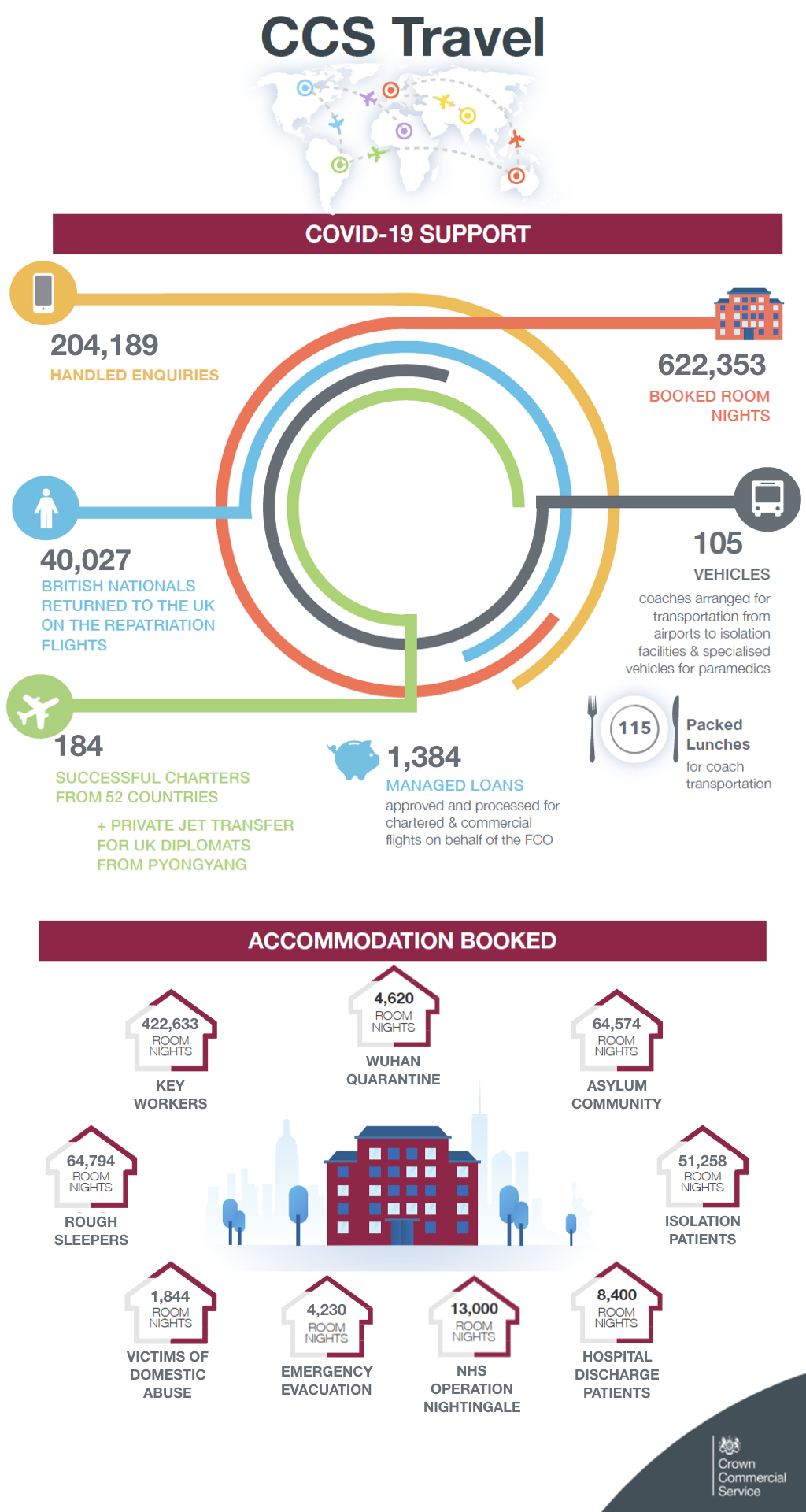
In the early days of the pandemic, our category experts played a vital role in the repatriation of British nationals and their families from overseas. We also played a critical role securing emergency accommodation for rough sleepers and victims of domestic abuse. 

We have continued to support the response throughout the pandemic, with our travel team helping to facilitate:

  • the booking of over 620,000 room nights for key workers, vulnerable people and the asylum community. This involved booking venues for exclusive use along with individual rooms.
  • the return of 40,000 people to the UK on repatriation flights – either on commercial flights or on the 184 charters arranged by our framework suppliers CTM
  • coaches to transport those returning to the UK from the airport to isolation facilities – along with providing specialised vehicles, when needed
  • our suppliers provided other services such as support for managing loans, to allow passengers to pay for repatriation flights and sourcing essential products such as microwaves and clothing for people required to go into quarantine immediately after arriving in the UK. 

Some of highlights of the work we’ve done to support our customers throughout the pandemic:

Let us take the strain

From helping repatriate Britons to securing temporary accommodation, assisted by our suppliers, we have responded at pace to our customers’ unique and varied requirements. But, with COVID-19 still placing restrictions on our daily lives, we know the job is far from over.

The travel team at CCS stand ready to assist with all your travel needs. For example, we are currently supporting several universities with their end-to-end transportation requirements and providing accommodation for the vulnerable.

Whatever your needs, our experts will have the solution.

  • to learn more about our travel category, visit our webpage
  • contact us to speak with an expert

London Fire Brigade simplify their facilities management procurement with CCS

The requirement

The London Fire Brigade wanted to simplify their facilities management procurement, by combining its cleaning, security, pest control and horticultural services contracts. They wanted to appoint a single supplier for a minimum of a 3-year period to deliver all four services for more than 100 operational fire states and 2 office buildings.

The solution

LFB initially reached out to CCS whilst assessing the current facilities management (FM) market conditions and procurement options as part of a wider strategy. LFB worked with the CCS to understand their FM offering, to help them decide if it was suitable for their needs as a route to market. CCS supported LFB throughout the process, helping them to develop their bid including the KPI model, payment mechanism, pricing models and evaluation criteria.

The result

By using the FM Marketplace framework, LFB successfully achieved its desired outcome of combining services into a single supplier contract to provide a simplified procurement route. They were impressed by the level of support provided by CCS throughout the entire process, in particular with the management of clarifications, assistance on all procurement related queries, support on process and contractual matters and thorough cost model organisation and analysis.

The entirety of the procurement process was run during the COVID-19 pandemic, forcing all members into unfamiliar working arrangements on both sides. Despite this added challenge, CCS were able to maintain consistent and regular communication and ensured that all target dates initially agreed upon were met. As a result of this, the procurement process was seamless and efficient, from the formalisation of the bid pack documentation to contract award.

Simplify your procurement today

At CCS, our aim is to help you make smarter buying decisions to help you add power to your procurement. Get in touch to find out how we can help you streamline your procurement.

Permanent Recruitment framework helps Maritime and Coastguard Agency get fit for the 21st century

The Maritime and Coastguard Agency (MCA), based in Southampton, was seeking an Executive Director of Technology to lead their digital transformation strategy. This was a new position that would play a pivotal role in the creation of the ‘Future Coastguard’ programme to ensure a coastguard fit for the 21st century.

Attracting the right talent

Recognising that the right calibre of candidate would be challenging to find, not least because of the location outside of London, MCA turned to the CCS Permanent Recruitment framework to find a specialist digital transformation recruiter. Following a further competition, they appointed Global Resourcing to manage this critical appointment.

Global Resourcing worked with MCA to create an eye-catching and vibrant campaign that would appeal to the tech community. They undertook all project planning, from timelines to document creation and advertising, working to the highest standards, as a valued and expert partner.

Global Resourcing accessed their extensive network of digital leadership professionals, conducting market mapping to develop a targeted approach. This included their national Women-In-Tech network and a proactive approach to encouraging applications from Black, Asian and Minority Ethnic (BAME) and other under-represented groups to ensure diversity within the candidate pool.

A successful campaign

Despite the role being based on the South Coast, the campaign generated 444 initial expressions of interest from a diverse cross section of industry professionals. This resulted in 122 full applications, of which 12 were taken through to the first interview stage. 

These interviews were conducted by Global Resourcing on-site at MCA, and 6 candidates with a 50/50 gender split were then invited to a panel interview. Individual leadership assessments were conducted to ensure that MCA could be confident in their final decision. 

The successful candidate was appointed from the private sector and has taken up their new position with MCA. Another candidate who applied under the Disability Confidence Scheme was offered an alternative role.

The campaign was completed in 9 weeks, which is a very swift turnaround for a crucial and dynamic leadership role within an exciting and innovative organisation.

The success and speed of this appointment has led MCA to use the framework again to fill a band 6 post.

Matthew Briggs, Director of Human Resources, Estates and Health and Safety at MCA said:

We have worked very closely with Global Resourcing over the last year to identify, attract and ultimately recruit a number of important senior and specialist roles. Their flexibility, positive attitude and efforts to understand our business and specific requirements have resulted in some great staff being recruited, and a much better marketplace brand for MCA.

You have the power to make better recruitment decisions

To find out how the CCS Permanent Recruitment Solutions framework can help you with your vacancies visit the framework web page.

For further advice and guidance please complete this short online form, email us or call us on 0345 410 2222.

Update to our online catalogue for technology products

An updated Technology Products online catalogue is now available on the Purchasing Platform. 

The catalogue gives you access to a range of IT hardware and software products through the new Technology Online Purchasing Content framework. This will replace the Technology Products 2 framework lot 6 catalogue when it expires on 31 October 2021. Until then, products will be available from suppliers on both frameworks. 

It has been designed to make it easy for you to make smaller or one-off purchases, and complements Technology Products and Associated Services. This means that whether you simply need to buy a memory stick or the components of an entire corporate ICT infrastructure, the catalogue is the ideal route to market. Products bought through the catalogue are off-the-shelf and come with a minimum warranty of 90 days. 

If you would like to see how the catalogue works, you can watch our short video on how to use the Purchasing Platform. 

If you are already registered on the platform, simply login to view the latest products available through the catalogue. 

If you do not have login details already, you will need to register as a buyer, which is a simple and quick process.For more information or to speak to a member of our team, please complete our form.

Local authorities, collate your IT requirements and save

In 2016, we ran a national further competition for IT hardware (EA16) using our Technology Products framework. The authorities that took part saved up to 44%. The savings were measured against a combination of current prices and independent third party benchmarks. 

Technology Products has now expired and been replaced by Technology Products and Associated Services (RM6068). Contracts put in place under the aggregation are also  due to expire very soon. 

The 34 authorities that took part in 2016 have decided to collate their requirements once again, and open the opportunity up to other local authorities so they too can benefit.

If you have current IT hardware requirements  why not let the team at CCS  take care of the process and find you the best possible deal?

Our approach

The aggregation will take an eAuction* approach, using web-based software so that potential suppliers can compete online, in real time, to provide the best possible prices for the goods/services under auction. 

To take part you will need to agree to purchase the same minimum technical specification of goods as all the other authorities taking part. Additional services including imaging, asset tagging, delivery and warranty options, as well as new services that are needed to cover the new homeworking requirements will also be available. 

Variances to technical specifications which cannot be included in the core specification can be addressed by the inclusion of optional upgrades and downgrades to meet your specific needs. 

The aggregation will use lot 1 of our Technology Products and Associated Services (RM6068) framework, and only suppliers that can fully meet the stringent qualitative requirements will take part in the eAuction. 

You will be able to place orders under the contract with the successful supplier over a 2 year period.

Get involved

Customer requirements will need to be submitted by January 2021. The procurement will be run in February/March 2021 with the eAuction  taking place in May 2021. Finally, customers should expect the final award to take place in June/July 2021.

To find out more about getting involved, please contact us by completing our form and quoting ‘EA21 IT hardware aggregation’’ in the comments box and one of our team will be in touch.

How aggregations work

National aggregated further competitions are a tried and tested approach which have achieved significant savings for our customers.

As a fully managed service funded by CCS, we will draft all documentation, build the specification and run the procurement for you. 

You just need to complete a form to express your interest, provide the final volume of services you need before we go to market and sign a contract with the successful supplier.

To find out about all our current and future opportunities, please visit the aggregation page on our website. 

*An electronic auction (eAuction) is a procurement tool that uses web-based software to allow potential suppliers to compete online, in real time, to provide prices for the goods/services under auction.